
EECinsights - Monty and Nmeso win CSaP Policy Innovation Fund grants
Some good news from the policy side of EECi: Nmeso and I have both been awarded micro-grants from the University of Cambridge’s Policy Innovation Fund, run by the Centre for Science and Policy (CSaP) with the University Research Office.
The fund provides seed funding to help researchers, including PhD students, build partnerships with policy partners and respond to pressing public policy challenges. This year, five projects across the University were selected for micro-grants of up to £2,000, and two of them are from EECi. Both build directly on our PhD research, and both are about getting that evidence in front of the people who design and deliver policy.
Governing Green: translating NHS decarbonisation research into policy practice
My project takes findings from my PhD on NHS hospital estates to the people who collect, manage and use national estate data. Net zero for the NHS by 2040 depends heavily on its estate, and two things make that harder. The first is the data: the Estates Returns Information Collection (ERIC) and Display Energy Certificates report at different levels and often don’t link up, and DECs are now being withdrawn following a government consultation. The second is the decisions: the route money takes through a Trust, whether team budgets, grants or Trust capital, decides what test a measure faces, and carbon only counts as a cash cost.
With NHS England as policy partner, including Fiona Daly, National Deputy Director of Estates, I’ll be running two workshops in London:
Evidence
What would make national estate data more useful for decisions, without adding to what Trusts already report?
The best way to report estate data, including but not limited to ERIC and DECs.
Who's in the room: NHS England data and analytics leads, Trust estates and ERIC reporting staff, and researchers.
Governance
What would help Trusts give carbon the same standing as cost and clinical risk?
How carbon can have a clearer place in Trust decisions: business cases, sequencing capital work, and ownership at board level.
Who's in the room: NHS England sustainability and net zero leads, Trust sustainability, capital, finance and senior leaders, and researchers.
Each workshop will bring together 15 to 20 people. The discussions will feed into an evidence briefing after the first workshop and a policy brief, co-produced with NHS England, in spring 2027.
If you work in NHS estates, energy or sustainability and would like to take part, you can register your interest on my website. You can also read more on the FIBE CDT news page.
Who Gets Left Behind? Equity Gaps in UK Retrofit Policy
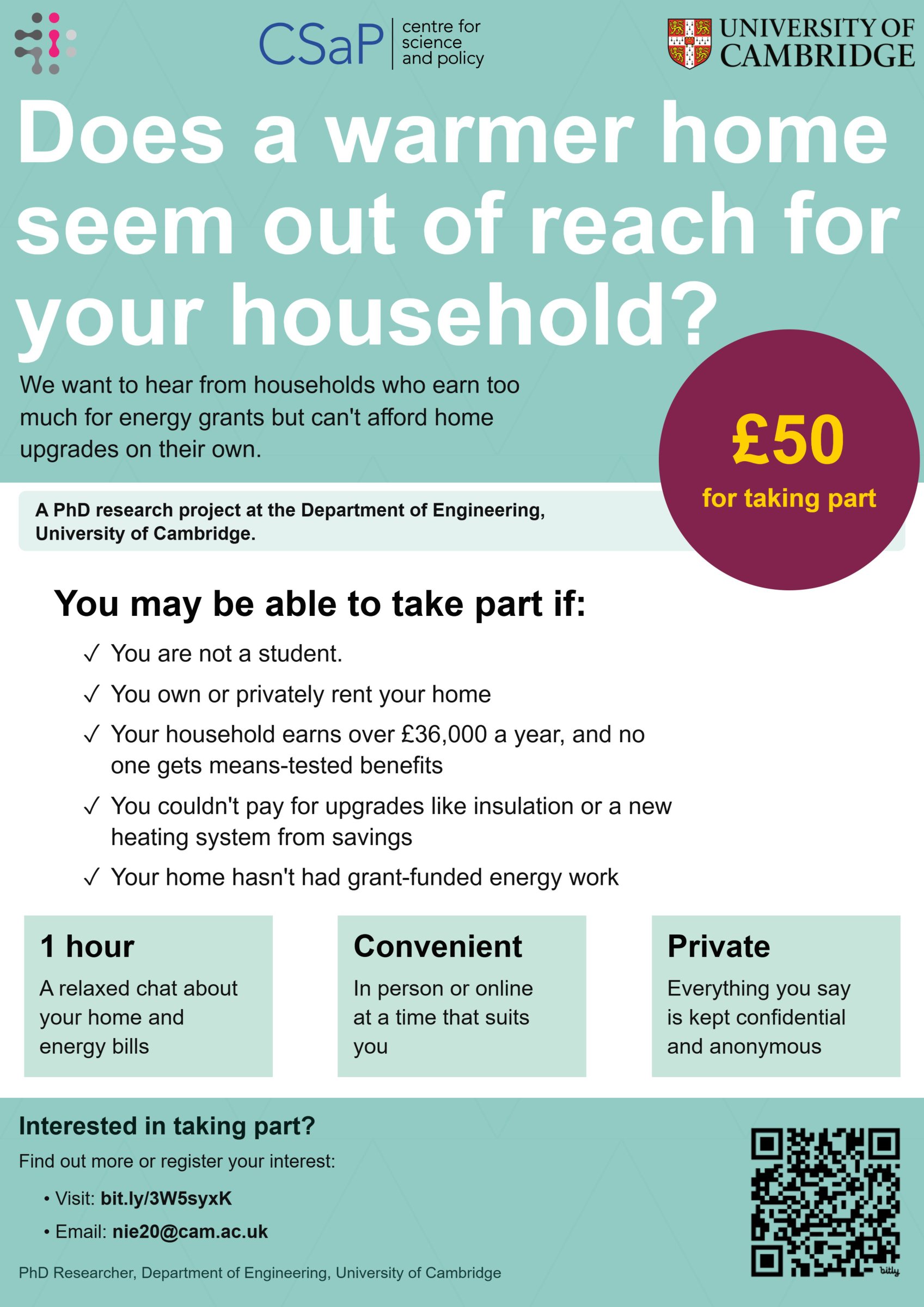
Nmeso’s project looks at the “missing middle” of home retrofit: households that sit above the income thresholds for grant schemes such as ECO4 and the Warm Homes Plan, but still can’t realistically pay for improvements themselves, whether because of financial pressure, insecure tenure, or a lack of accessible information about what retrofit could look like for their home.
Nmeso’s PhD models already estimate how many households fall into this gap and where they are, broken down by income, tenure, deprivation and other socio-demographic factors. The micro-grant adds the other half of the picture: a programme of semi-structured interviews with households in that in-between space, exploring the barriers they face and the combinations of support that could realistically unlock action. The model shows how many households are affected and where; the interviews will show why they are stuck and what might change that.
The findings will be turned into household case studies that map barriers onto practical pathways, such as combinations of information, subsidy, tenure protection or installer access, along with a policy brief aimed at the design of retrofit schemes. The project’s policy partner is the Department for Energy Security and Net Zero (DESNZ), which will host a dissemination event with officials working on the retrofit funding landscape.
Nmeso is now recruiting households to take part. You may be eligible if you are not a student, you own or privately rent your home, your household earns over £36,000 a year with no one receiving means-tested benefits, you couldn’t pay for upgrades like insulation or a new heating system from savings, and your home hasn’t had grant-funded energy work. Interviews last about an hour, in person or online, are kept confidential and anonymous, and participants receive £50. If that sounds like you, or someone you know, you can sign up here.
What’s next
Both projects run through the winter and into spring 2027, so look out for updates here as the workshops, interviews and policy briefs take shape. Congratulations to Nmeso, and thank you to CSaP and the selection panel for supporting both projects.
